

#011: Kibbe Body Types
Do you know how to dress for your silhouette?

Sometime mid-last year, I learned about Kibbe body types. Such an easy topic to get lost in. It was the first time I had ever heard of the term, but I soon discovered an entire niche of YouTubers who talk mainly about it, Pinterest references, blog posts, and crazy amounts of subreddits. I know that's precisely how the internet works, but I'm always amazed when I spot some extremely popular content or people I've never seen. It chocks me every time!
David Kibbe is an American beauty guru from the '80s who wrote the book “Metamorphosis: Discover Your Image Identity and Dazzle As Only You Can” Suggestive, right? He created a system that categorizes bodies based on people's features to understand what clothing would suit them best. He became very famous for it back in the day.
His idea is to figure out the main aspects of your silhouette to emulate those characteristics in your clothing, creating more harmonious looks and flattering your natural features. He leans into the idea of yin and yang being a range from feminine to masculine essence, with the most yin features being small, rounded, and delicate, while yang is sharper, more angular, and longer.
The image below is the most illustrative I found:
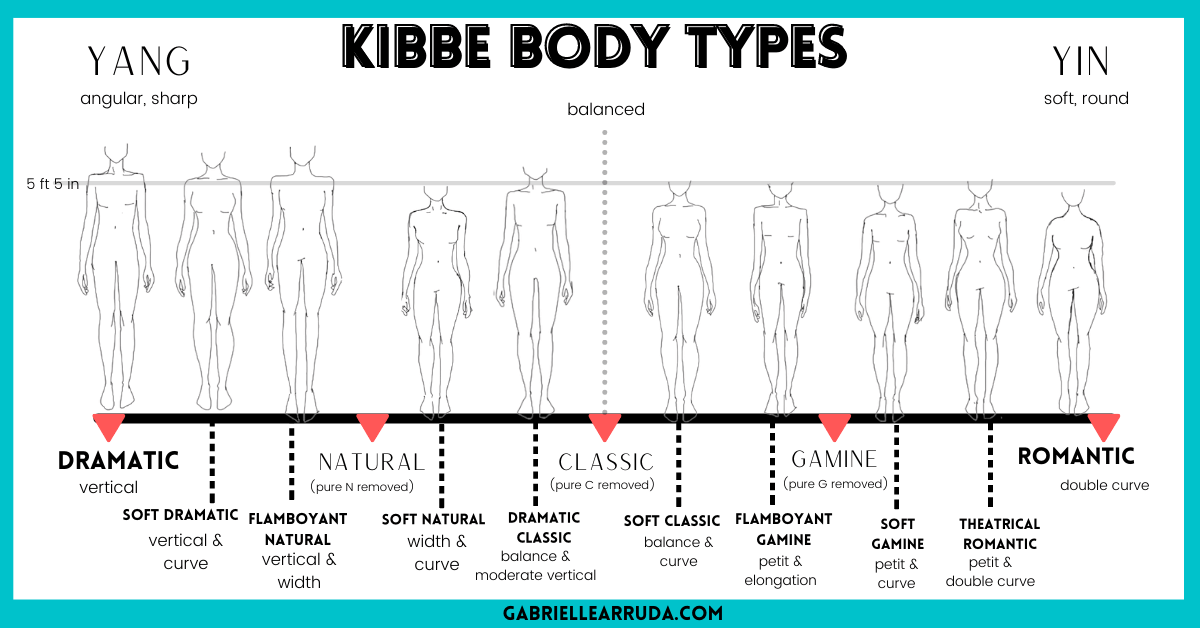
Within this yin-yang range, Kibbe categorized 13 (and later reduced to 10) body types based on vertical lines, width, curves, and facial features. But nobody cares about the facial features part, hence the faceless bodies above. Dramatics are long and narrow, naturals have wide shoulders, classics have balanced ying and yang features, gamines have contrasted ying and yang features, and romantics are short and curvy.
When you read or watch things about it, though, the whole system feels quite complex. There's even a test to figure out what body type you are. I did this one with myself and a few friends. I love tests. But I’ll confess I left it more confused than I started because it's super complicated. There are questions like "Is your shoulder round or angular?" and well, the only non-round shoulders I've ever seen were Lady Gaga's in the Born This Way music video.
The test requires looking into many details about your own body, which can be discomforting depending on your headspace and current relationship with your figure. So, trigger warning.
Ultimately what I did, and what I believe most people do, was look at references to identify what looked closest to what I see in the mirror. I keep changing my mind about being a dramatic classic or a very skinny soft classic. I see myself in both. Maybe I'm the one existing pure classic — no idea why Kibbe removed the category in the first place.
After you know your body type, there are loads of references and content online to learn more about it. But it's pretty self-explanatory at this point: if you have a romantic body, dressing in romantic lines and patterns would be the most flattering; if you have a more dramatic silhouette, then dramatic shapes and fabrics will enhance that on you.
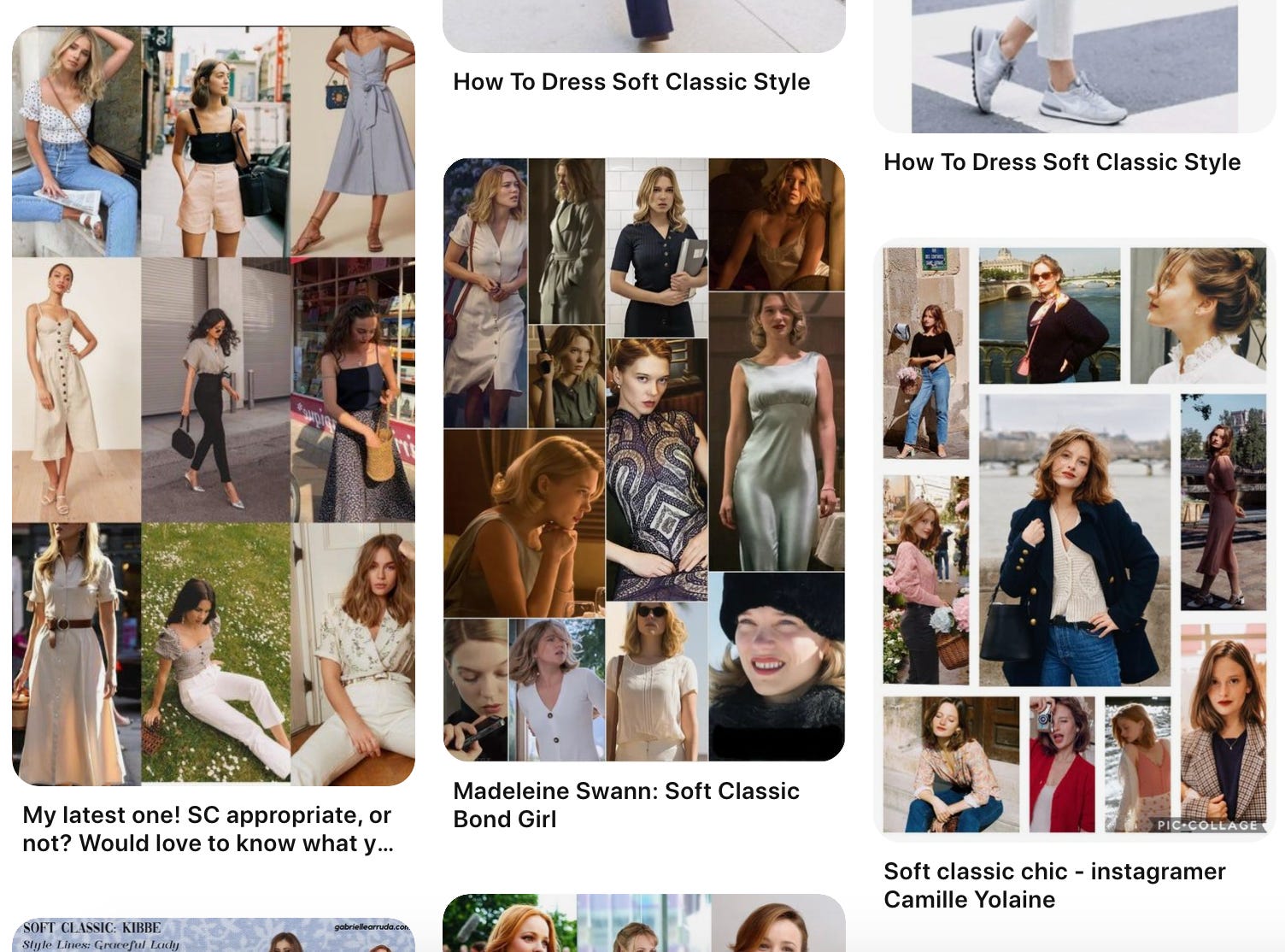
Now, I know how it all sounds. This is restrictive, too binary, and if you look for references, they're mostly white and thin. I know. But I work with guidelines and takeaways, not rules. And that's what I'm going to share with you next.
My Takeaways
There's no need to reinvent the wheel
I remember this one instance when the company I work at went through a rebranding. I think it was the new website they were working on then. The elements of the new brand are overall very bold, sharp, and edgy, but there were some buttons here and there that were round, small, and cute. They gave off another vibe, and it was kind of random.
The immediate feedback the page received was: this looks a bit off. And it did. The elements were clashing; although the page didn't look bad, it could be improved. The buttons were then changed, not to look all squarish and angular like everything else, they still had some roundness to them, but they were bolder and more intentionally in sync with the rest of the page. It was a subtle change, but it made all the difference.
I think that's precisely what Kibbe suggests we do with our clothing, but he overcomplicates it. Forget typing. When considering patterns, fabrics, textures, and shapes, the more we mimic our body lines, the more our looks will feel cohesive.
This is all very intuitive
We've all had moments when we saw someone wearing something that looked gorgeous on them, but when we tried it on ourselves, it didn't look so great. And we couldn't tell why, we just knew. It probably had to do with this principle.
For this one, I have MANY examples. But I'll use the most obvious that comes to mind: oversized jackets. I think they're beautiful and stylish. I love them. Do I effortlessly rock them, though? No, I don't. Although I'm kind of tall, I'm pretty tiny, so I usually look like I'm being swallowed by them - especially if they have shoulder pads. My body features are balanced. If I add too much weight to one half of it, the other instantly looks too small. When I wear those, my legs have a high chance of looking like two little chopsticks.
It's not rocket science, I didn't need Kibbe to figure it out. But reading about it helped me understand why I think some things look less flattering on me than others. And they don't necessarily look bad, I just need extra confidence to look snatched in them. With oversized coats, I often feel that I need to create balance on the bottom half of my body.
The key is intentionality
The way one dresses is entirely up to them, and fashion is there to serve you, not the other way around. So these are not rules, they could never be. However, on some occasions, you'll want to be more intentional about it than others.
Sometimes, you could think of fashion as art. It doesn't need to make sense. You wear whatever you want, however you want, not caring about what anybody thinks. That's the goal, right? Or perhaps you need to be practical and not think much about it. Then screw Kibbe.
But at other times, impressions matter. You're going to want to communicate something. Maybe it's for work or meeting someone important. You may need to evoke something specific. In these cases, using Kibbe as a tool is an interesting thought.
For example, I noticed that when I dress according to the classic vibe I give off, people do, in fact, go out of their way to compliment my outfit. Even if it's jeans and a cropped top. I find it funny, but it could be useful.
It also works if you dress just slightly outside of what's obvious for your silhouette. The most common example people mention is Alexa Chung, who used to dress with gamine styles while having dramatic proportions. The way she mixed and matched elements created a distinct look that got her a lot of attention - and money!!!! - in the 00s. I don't think she knew Kibbe, though.

The point is that style is a personal thing that should make you feel good and comfortable. But within that, considering your likes and dislikes, if you have the tools, you can leverage the perception you create in others according to your context. And I think that's quite clever.
Take it with several grains of salt
Nothing is set in stone:
Kibbe is an American stylist who created this system in the 80s, and perceptions can be limited to time and space. I saw a documentary once that showed how the same chords and arrangement of a song sounded sad for some cultures and happy for others, and how that's traced to the history of each of them with those sounds. I guess that can happen with pretty much everything. Perception is subjected to culture, I even wrote about this here. Fashion is no different.
References online can be deceiving. They're not always good, so we need to trust our gut. As a soft classic, I can easily fall into the rabbit hole of business casual outfits when looking for ideas. They look good on me indeed, but it's not all I want to wear. The same happens with soft naturals, who could be led to think they should only dress as if they were going to Coachella circa 2014. That's not the case. We need some austerity when dealing with this.
The most fun way to use it
If I'm being honest with you, the fun is in the research. This can feel as random as any other online test we take. It turns out that most of the knowledge I acquired in Kibbe was used to analyze storytelling in movies and series. I'm obsessed. I love looking at characters and noticing the tricks in styling that help communicate their development and express their feelings. Then guessing what the actresses’ body types are, why they were cast for that role, why that set of costumes was chosen for them, and what I'd do differently. Just pretending I know as much as a costume designer does - which is inaccurate, but fun regardless.
Fun fact
I thought Kibbe was a dead man for the longest time, but he was famous in the 1980s, not the 1880s! He is alive and well, working in New York while keeping a low profile. He has this picturesque website and is active on Facebook, where he offers his services and has groups to style men and women. Interestingly, I was very underwhelmed by his results applying his own system. Intriguing, to say the least.
Portuguese Nonsense
Quanto vocês estão por dentro de discussões sobre inteligência artificial? Confesso que tenho mais pensando nos benefícios do que qualquer outra coisa. Uso um bocado no trabalho, e para esta newsletter, resolvi brincar de brand manager com o Chat GPT. Por isso, vocês vão ver algumas mudanças de cores, imagens, fontes e descrições por aqui. Tudo muito tímido, porque é só de brincadeirinha.
Mas eu estava pensando na quantidade de informações falsas e na velocidade que elas podem ser fabricadas, e no quanto essas falsidades podem se misturar com verdades. A IA consegue distinguir verdade de mentira? E se não conseguir, quanto tempo vocês acham que demora até o conteúdo que ela fornece começar a nos causar um nó, a ponto de nem nós mesmos conseguirmos distinguir fato de fake de forma mais generalizada?
Acho um pouco assustador de pensar.
Num lado mais otimista do espectro, achei um caso de uso bem interessante para o fim do mês e gostaria de compartilhar:

Estamos no meio do mês, fica aí a dica para as próximas semanas, antes do próximo VR cair.
From my browser to yours
Burnout, Boundaries, And The Lie Of Consumerist Self-Help: Cool conversation between Chelsea Fagan and Taylor Morrison about the performative self-help culture and what self-care is in reality. A topic that aligns well with my Pilot issue here at SooperThoughts.
Hollywood child stars now: I'm usually bombarded with so much content about nepobabies. People everywhere are pissed at them for how easily they get things. It's so widespread that I think I'm all caught up with Hollywood's unfair environment. But in another corner of YouTube, I landed on Christy Carlson Romano's podcast, and I was shocked. She acted on Disney's Even Stevens (Mano a Mana) from 2000 to 2003 alongside Shia LaBeouf. Now she interviews other former child stars like herself on her channel. I imagined the lives of non-nepokids in Hollywood were not easy, but seeing them discussing it is pretty disturbing. One cool thing that I learned, though, is that some of these now adult actors are creating ways to protect and avoid a new generation of kids falling victim to the system as they did. The two episodes I recommend:
Alexa Nikolas (Zoey 101): The girl was heavily bullied by the show's young cast and harassed by the adult crew. Only to later go through an abusive relationship with someone much older within the music industry, supported by the record label, while still in her teens. Now she's joining forces with other survivors to protest against those big corporations.
Alison Stoner (Cheaper by the Dozen / Camp Rock): She was way less specific about what happened to her (thankfully) but very clear about the environment she and the other kids and teens were subjected to. She expanded on how it affected kids’ entire families and how the parents were just as unprepared and clueless as them. She's now working on a product to help kids and families navigate the system. After validating the business model, she hopes to replicate it in other industries. I personally think this is very cool.
Figma Best: This is for my designer friends. The site clusters a bunch of Twitter threads with Figma tips. Very useful, I think.
Music Space
I had forgotten how much I like AlunaGeorge. And Kaytranada. This is my humble musical share today: